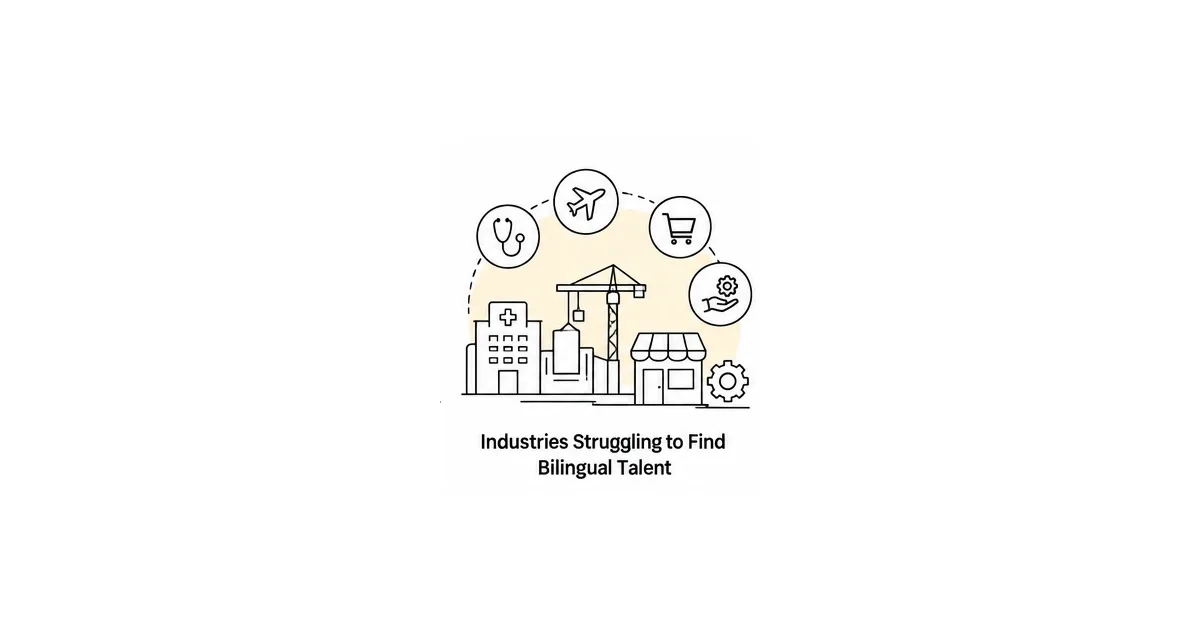
The Industries Struggling to Find multilingual Talent
For years, many hiring managers treated multilingual ability as an added bonus rather than a core job requirement. It was a useful addition to a resume, but rarely considered essential outside customer support, translation, or international sales.
That approach is becoming harder to justify.
Across the United States, businesses serve increasingly diverse communities, coordinate international supply chains, and compete for customers across language barriers. Employers need people who can combine professional expertise with the ability to communicate effectively in more than one language.
Yet finding candidates who possess both skills can be challenging. Speaking Spanish, Mandarin, or Arabic is one thing. Applying that language confidently in a medical setting, a financial negotiation, or a complex logistics operation is another.
Research has long highlighted the value of multilingual skills in the US labor market. A study published in Foreign Language Annals found that employers sought language skills alongside capabilities such as customer service, sales, marketing, and vendor management. The American Immigration Council has also documented substantial growth in US job postings requesting multilingual workers between 2010 and 2015. Although these figures are historical, they demonstrate that demand for multilingual talent extends well beyond traditional translation roles. <Link url="https://www.onlinelibrary.wiley.com/doi/abs/10.1111/flan.12241" title="Read the employer research"/> or explore the <Link url="https://www.americanimmigrationcouncil.org/report/not-lost-in-translation-the-growing-importance-of-foreign-language-skills-in-the-u-s-job-market/" title="American Immigration Council report"/>.
So where does multilingual talent make the biggest difference, and what can employers do to recruit it more effectively?
1. Healthcare: Where Communication Can Affect Patient Safety
Healthcare is one of the clearest examples of why language skills matter in the workplace.
When patients and healthcare professionals struggle to understand one another, explaining symptoms, discussing treatment options, and obtaining informed consent can become more difficult. Clear communication is particularly important when patients are discussing complex diagnoses, medication instructions, or ongoing care.
The scale of the need is significant. According to the US Census Bureau's 2024 American Community Survey, approximately 43 million people in the United States spoke Spanish at home. Millions more spoke Chinese, Vietnamese, Arabic, and other languages. These figures measure language use at home, rather than professional proficiency or demand for multilingual healthcare workers, but they illustrate the linguistic diversity healthcare organizations serve. <Link url="https://data.census.gov/table/ACSST1Y2024.S1601" title="Explore the Census Bureau's language data"/>.
Healthcare employers may need multilingual professionals across several roles:
Nurses and patient care staff: Communicating with patients about symptoms, care instructions, and follow-up appointments.
Patient access and scheduling teams: Helping patients navigate appointments, registration, billing questions, and referrals.
Care coordinators: Supporting patients as they move between providers, treatments, and community services.
Medical interpreters: Facilitating communication when patients and clinicians do not share a language.
However, speaking a patient's language does not automatically qualify someone to interpret complex medical information professionally. Healthcare organizations must distinguish between general multilingual communication and the specialized skills required for medical interpreting.
What employers can do: Identify the roles where language skills make a measurable difference, assess candidates' proficiency against those responsibilities, and provide qualified interpreters when needed. This creates a more reliable approach than expecting every multilingual employee to handle every language-related task.
2. Logistics and Supply Chain: Keeping International Operations Moving
Logistics is another sector where communication across languages can support smoother operations.
US businesses depend on extensive domestic and international supply chains. Companies moving goods across the US-Mexico border, coordinating overseas suppliers, or managing multilingual warehouse teams often need employees who can communicate clearly across different working environments.
Language skills can be particularly useful in roles where delays, unclear instructions, or documentation errors create operational problems.
Examples include:
Dispatchers and fleet coordinators: Communicating instructions, resolving delivery issues, and coordinating drivers and customers.
Customs and trade compliance specialists: Working with international partners on shipping documents, product information, and cross-border requirements.
Warehouse supervisors: Explaining safety procedures, coordinating shifts, and ensuring team members understand operational instructions.
Procurement and supplier relationship managers: Negotiating with overseas suppliers, clarifying specifications, and resolving order discrepancies.
In these positions, language ability can help employees resolve issues directly rather than relying entirely on colleagues or external support.
Nevertheless, multilingual proficiency is only one part of the job. A multilingual dispatcher still needs strong organizational skills, while a customs specialist must understand applicable regulations and documentation requirements.
What employers can do: Include language requirements where they genuinely support operational performance. Assess candidates using realistic workplace scenarios, such as explaining a delivery delay, resolving a supplier disagreement, or communicating a safety instruction.
Employers should also consider whether the role requires conversational proficiency, professional writing, technical terminology, or a combination of these skills.
3. Financial Services: Building Trust Through Clear Communication
Financial services depend on trust, accuracy, and a clear understanding of complex information.
Whether a customer is applying for a mortgage, opening a business account, discussing insurance coverage, or seeking financial advice, misunderstandings can have serious consequences.
For banks, lenders, insurers, and financial technology companies serving multilingual communities, employees who can communicate effectively in a customer's preferred language may help improve accessibility and strengthen relationships.
Potential areas of demand include:
Personal and business banking: Helping customers understand accounts, services, lending options, and documentation requirements.
Mortgage and lending: Explaining application processes, interest rates, repayment terms, and required paperwork.
Insurance services: Discussing policy features, exclusions, claims procedures, and coverage options.
Financial customer support: Resolving account issues and explaining products to customers who prefer another language.
The value of multilingual employees is not limited to customer-facing positions. Language skills can also support international business development, supplier relationships, and communication with overseas partners.
However, financial knowledge and regulatory competence remain essential. A candidate who speaks fluent Spanish may communicate well with Spanish-speaking customers, but still needs the appropriate training and qualifications to provide regulated financial advice where required.
What employers can do: Assess language proficiency alongside financial knowledge, customer service ability, and any relevant licensing requirements. Give candidates a realistic opportunity to demonstrate how they would explain a financial product or respond to a customer question in the target language.
4. Government and Public Services: Making Essential Information Accessible
Public agencies also rely on effective communication with people who speak different languages.
Local governments, emergency services, courts, public health departments, and social service organizations may need to communicate important information to residents who are not proficient in English.
The roles involved vary widely, but can include:
Public service representatives: Helping residents navigate applications, benefits, permits, and local services.
Emergency communications personnel: Gathering and relaying critical information during urgent situations, subject to the language capabilities and requirements of the role.
Social workers and community outreach staff: Explaining available services and supporting communication with individuals and families.
Court and administrative interpreters: Facilitating accurate communication in formal proceedings and other settings where qualified interpretation is required.
These positions can demand more than conversational ability. Employees may need to communicate accurately under pressure, understand specialized terminology, and follow strict confidentiality or procedural requirements.
Public agencies must also balance recruitment needs with established hiring procedures, pay structures, and qualification standards. In some locations, competition from private employers may make it harder to attract candidates with the right combination of skills.
What employers can do: Identify the languages most relevant to the communities they serve, establish appropriate proficiency standards, and make sure language requirements reflect actual responsibilities. Where qualified interpretation is necessary, agencies should use appropriately trained professionals rather than assuming that any multilingual employee can fill the role.
Why Finding the Right multilingual Candidates Can Be Difficult
The challenge is not simply finding people who speak two or more languages. It is finding candidates whose language proficiency matches the demands of a particular job.
Consider three examples:
A customer service representative may need to explain routine account information clearly and empathetically.
A logistics manager may need to negotiate with suppliers, understand technical terminology, and resolve unexpected delivery problems.
A healthcare interpreter may need specialized training and the ability to communicate complex medical information accurately and impartially.
All three positions involve language skills, but the required competencies are very different.
Employers can run into difficulties when they use vague requirements such as "fluent in Spanish" without specifying whether the role involves phone conversations, professional writing, technical discussions, or formal interpretation.
Another challenge is treating language proficiency as a substitute for industry experience. A candidate may speak fluent Mandarin but lack the financial expertise required for a banking role. Conversely, an experienced financial professional may have strong technical skills and intermediate Mandarin that could improve with further training.
The most effective hiring strategies recognize these distinctions instead of searching for a candidate who supposedly excels at everything.
How Employers Can Compete for Multilingual Talent
Organizations that need multilingual employees can improve their recruitment strategies in several practical ways.
1. Define the Actual Language Requirements
Replace vague descriptions with clear examples of what the employee must be able to do.
Instead of simply requiring "business-fluent German," explain whether the candidate must lead client meetings, write proposals, negotiate contracts, or respond to customer inquiries.
This helps candidates assess their suitability and allows recruiters to evaluate applicants more consistently.
2. Offer Competitive Compensation
Where language proficiency is essential to a role, employers should consider whether their compensation reflects that requirement.
Depending on the position and market, this could involve a language premium, a higher salary range, or a clearly defined bonus for additional responsibilities.
Compensation should reflect the value and complexity of the work, rather than assuming that multilingual candidates will accept extra duties simply because they speak another language.
3. Assess Practical Ability, Not Just Self-Reported Fluency
Asking candidates to label themselves "fluent" or "conversational" provides limited information on its own.
Structured assessments can help employers evaluate how candidates communicate in realistic work situations. These might include writing a customer email, explaining a product, handling a simulated complaint, or discussing a technical issue in the target language.
For specialized roles, employers should use assessments appropriate to the relevant professional standards.
4. Broaden the Candidate Search
Employers may overlook qualified candidates by relying too heavily on conventional recruitment channels or unnecessarily restrictive degree requirements.
Consider candidates from different industries who have transferable skills, professionals with international experience, and applicants whose language abilities were developed outside formal education.
Where a specific qualification is not essential to the job, practical assessments and relevant experience may provide a more useful indication of suitability.
5. Develop Existing Employees
Recruitment is not the only solution.
Organizations may be able to develop existing employees through language training, specialist terminology courses, and opportunities to work with international teams.
This approach can be particularly effective when employees already possess the necessary technical or professional expertise but need additional language skills to progress into new responsibilities.
The Bottom Line
Multilingual talent can help businesses improve customer communication, strengthen international relationships, and serve communities with diverse language needs.
Healthcare, logistics, financial services, and public administration illustrate how these skills can contribute to important professional tasks. But the need is not identical across industries, employers, or individual positions.
The real recruitment challenge is finding people who combine the right language proficiency with the professional knowledge and practical skills the role demands.
Employers that define their requirements clearly, assess candidates fairly, offer appropriate compensation, and invest in developing talent will be better positioned to build effective multilingual teams.
For businesses competing in an increasingly connected economy, language skills are worth treating as a strategic hiring consideration, not merely an optional extra.