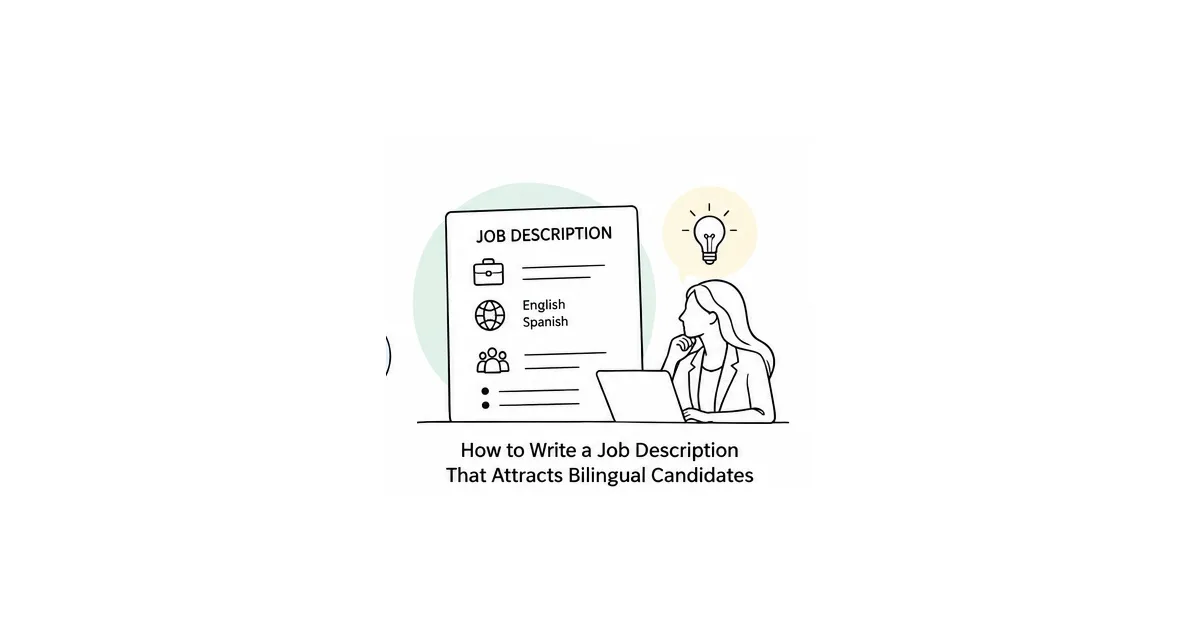
How to Write a Job Description That Attracts multilingual Candidates
When companies expand into new markets, serve multilingual customers, or build international teams, hiring employees with the right language skills can become a business priority.
However, finding suitable candidates starts with the job description.
Many multilingual job postings rely on vague phrases such as "fluent in Spanish," "multilingual preferred," or "must speak another language." These statements do little to explain how candidates will use their language skills, what level of proficiency is required, or why the role is worth pursuing.
The result can be a mismatch between applicants' abilities and the employer's expectations. Candidates may apply without the necessary professional language skills, while experienced multilingual professionals may overlook a vacancy because the responsibilities and compensation are unclear.
A well-written job description can help solve this problem. By connecting language requirements to real workplace responsibilities, employers can attract more relevant applicants and make the recruitment process more efficient.
Here is how to write a job description that appeals to qualified multilingual and multilingual candidates in the United States.
1. Replace Vague Language Requirements With Clear Expectations
The word "fluent" can mean different things to different people. One candidate might use it to describe everyday conversation, while another uses it to describe the ability to negotiate contracts, write detailed reports, and present to senior executives.
Rather than relying on a single word, explain what candidates must be able to do.
Use recognized proficiency frameworks where appropriate
The Common European Framework of Reference for Languages (CEFR) and the American Council on the Teaching of Foreign Languages (ACTFL) proficiency guidelines provide useful ways to describe language ability.
For example, CEFR levels range from A1 and A2 for basic users through B1 and B2 for increasingly independent communication, to C1 and C2 for advanced proficiency.
These frameworks can help employers communicate expectations, but they should not be treated as interchangeable systems or as guarantees of performance in a particular job. The appropriate level depends on the tasks involved.
Instead of writing:
"Must be fluent in German."
Consider writing:
"Professional German proficiency required. The successful candidate will deliver product presentations, respond to customer questions, and discuss commercial terms with German-speaking clients."
If you use a formal proficiency level, connect it to the actual requirements:
"Advanced German proficiency, approximately CEFR C1, preferred. Candidates must be able to lead client meetings, explain complex product information, and communicate professionally in unscripted discussions."
This approach gives applicants a clearer understanding of the role and provides recruiters with a more useful basis for screening.
2. Explain Exactly How the Language Will Be Used
Qualified multilingual professionals want to understand how their language skills fit into the job. Will they manage customer relationships, write reports, negotiate contracts, or communicate with colleagues in international offices?
A job description should answer these questions.
Specify written and spoken responsibilities
Distinguish between the communication tasks involved.
For example:
Written communication: Preparing emails, proposals, reports, customer responses, or technical documentation.
Spoken communication: Leading meetings, handling customer calls, delivering presentations, or negotiating with business partners.
Listening and comprehension: Understanding customer requirements, following instructions, and identifying important details during discussions.
Reading: Reviewing documents, interpreting customer requests, or understanding technical information.
Not every position requires all four skills at the same level. Focus on those that matter for the work.
Explain the business context
The same language can be used in very different professional settings.
A customer service representative may need to resolve routine inquiries in Spanish. A software salesperson may need to explain technical features and negotiate commercial terms in Mandarin. A healthcare professional may need to communicate accurately about sensitive information while meeting applicable professional requirements.
Specify the context rather than simply listing the language.
For example:
"Use professional Spanish to support customer onboarding, resolve account questions, and communicate service updates to clients across the United States."
This helps candidates assess their suitability and understand the value of their contribution.
3. Distinguish Essential Language Skills From Preferred Skills
One of the easiest ways to discourage qualified applicants is to make every language requirement sound mandatory, even when the role does not genuinely need it.
Before publishing the job, decide whether the language is essential, preferred, or useful only in certain circumstances.
Essential requirement: The employee must use the language regularly to perform core duties.
Preferred qualification: The language would be beneficial, but candidates can perform the main responsibilities without it.
Additional advantage: The language may help with occasional customer or team interactions but is not a central requirement.
For example, a customer support role serving a Spanish-speaking customer base may genuinely require professional Spanish. A general operations role with occasional contact with Spanish-speaking colleagues may not.
Being precise helps candidates understand whether they should apply and can widen the pool of qualified applicants when a language is not essential.
It also helps employers avoid unnecessarily restrictive hiring criteria.
4. Describe Industry Knowledge and Professional Skills Alongside Language Ability
Language proficiency alone does not make someone suitable for a position.
Employers often need candidates who combine language skills with industry knowledge, commercial experience, technical ability, or customer-facing expertise.
Make these requirements clear in the job description.
For example, a multilingual sales position might require:
Professional proficiency in English and Spanish.
Experience selling business-to-business products or services.
Strong presentation and negotiation skills.
Experience managing customer relationships through a sales cycle.
The ability to explain technical or commercial information in Spanish.
For a logistics position, the emphasis might instead be on shipment coordination, supplier communication, documentation, and industry-specific terminology.
Be careful not to create an unrealistic list of requirements. Focus on the skills that are genuinely necessary on day one, distinguishing them from capabilities that can be developed through training.
5. Include Cultural Awareness Without Relying on Stereotypes
Effective multilingual communication can involve more than translating words accurately. Employees may need to adapt their tone, explain unfamiliar concepts, and communicate appropriately with customers or colleagues in different markets.
Where this matters to the role, describe the relevant experience directly.
For example:
"Experience supporting business relationships across Latin American markets, with the ability to adapt communication to different customers and professional contexts."
This is more useful than assuming that all speakers of a language share the same cultural knowledge.
Avoid vague requirements such as "must understand Latin culture." Latin America includes many countries, communities, and business environments, and expectations vary by audience and situation.
Instead, identify the actual market, customer group, or type of communication involved.
6. Make Compensation and Responsibilities Clear
multilingual professionals may be expected to manage additional communication tasks on top of their main responsibilities. If the job description does not explain how those duties fit into the role, candidates may be reluctant to apply.
Be transparent about compensation
Where possible, provide a salary range that reflects the responsibilities and required experience.
If your organization offers a language differential, stipend, or other additional compensation for verified language skills, explain the arrangement clearly. Not every multilingual position commands a separate premium, so compensation should reflect the role, market conditions, proficiency requirements, and overall workload.
Define the boundaries of the role
Explain how the language will be used and what the employee will be responsible for.
For example:
"Spanish will be used primarily for customer onboarding, account support, and service-related communication. The role does not require full-time translation services."
Only include wording like this if it accurately reflects the position.
Clear expectations help candidates understand the job and reduce the risk of employees being routinely assigned unrelated translation or interpretation work without appropriate planning.
Show candidates the opportunity
Explain what the role offers beyond the language requirement. Highlight career development, team collaboration, customer impact, international exposure, or opportunities to grow into more senior responsibilities.
A strong job description should explain why a qualified candidate would want to join your organization, not just what the employer expects from them.
7. Use an Inclusive, Candidate-Friendly Job Description Structure
A well-organized job posting makes it easier for candidates to determine whether they meet the requirements.
Consider using this structure:
Job title: Use a recognizable title that reflects the actual position.
Role summary: Explain the purpose of the job and how the language skills support the business.
Key responsibilities: Describe the work the employee will perform.
Language requirements: Specify the languages, proficiency expectations, and communication tasks.
Professional qualifications: Outline the necessary experience, technical skills, and credentials.
Compensation and benefits: Include the available salary range and relevant benefits where possible.
Work arrangements: State the location, remote or hybrid arrangements, and any travel requirements.
Application process: Explain what candidates should submit and whether a job-related language assessment forms part of the selection process.
Use clear, inclusive language and avoid unnecessary qualifications that do not contribute to job performance.
If you plan to assess language proficiency during the interview, say so in the posting where appropriate. This sets expectations and gives applicants an opportunity to prepare.
8. Example: A Better Job Description for a multilingual Role
The following example illustrates how to bring these principles together.
multilingual Customer Success Specialist, English and Spanish
Location: United States
Work arrangement: Hybrid or remote, depending on business requirements
Compensation: Insert the approved salary range
About the role
We are looking for a customer-focused professional who can support English- and Spanish-speaking customers throughout their experience with our products and services. You will help customers resolve account questions, understand product features, and get the most value from our solutions.
Key responsibilities
Communicate with customers in English and Spanish by phone, email, and video meeting.
Support onboarding, account questions, and service-related inquiries.
Explain product features and processes clearly to customers with different levels of technical knowledge.
Document customer interactions accurately in our customer relationship management system.
Collaborate with sales, support, and operations teams to resolve customer issues.
Language requirements
Professional Spanish proficiency sufficient to manage customer conversations and write clear business correspondence.
Strong written and spoken English.
Ability to explain information clearly, ask relevant questions, and adapt communication to different customer needs.
Language skills will be assessed through job-related interview questions or practical exercises.
Required experience
Experience in customer service, customer success, account management, or a related field.
Strong communication, problem-solving, and organizational skills.
Comfort using digital tools to document customer interactions and manage follow-up tasks.
What we offer
Include the approved compensation, benefits, training, and career development opportunities.
This example gives candidates a clear picture of the role without relying on vague labels or imposing an arbitrary proficiency level. Employers should adapt the requirements to the actual duties, customer base, and communication demands of each position.
Quick Checklist Before Publishing Your Job Posting
Before advertising your next multilingual vacancy, check the following:
Have you explained why the language is needed?
Have you distinguished essential requirements from preferred skills?
Have you specified the speaking, writing, listening, or reading tasks involved?
Have you described the relevant industry experience and professional qualifications?
Have you explained how language proficiency will be assessed?
Have you provided clear information about compensation and responsibilities?
Have you removed unnecessary requirements that could discourage suitable candidates?
Have you made the application process straightforward and accessible?
Final Thoughts: Write for the Candidate You Want to Hire
A strong multilingual job description does more than mention a language. It explains how the employee will use that language, what level of communication the job requires, and how their professional skills will contribute to the business.
When employers set clear expectations, describe responsibilities accurately, and communicate the value of the opportunity, they can make it easier for suitable candidates to recognize a good match.
The result is a more focused recruitment process, better-informed applicants, and a stronger foundation for assessing candidates consistently.
Looking to hire multilingual or multilingual professionals in the United States?
LingoLava connects US businesses with skilled multilingual professionals across industries and functions. Whether you are hiring for sales, customer success, operations, or specialist roles, we can help you approach multilingual recruitment with a focus on language requirements and professional expertise.
Contact LingoLava to discuss your multilingual hiring needs