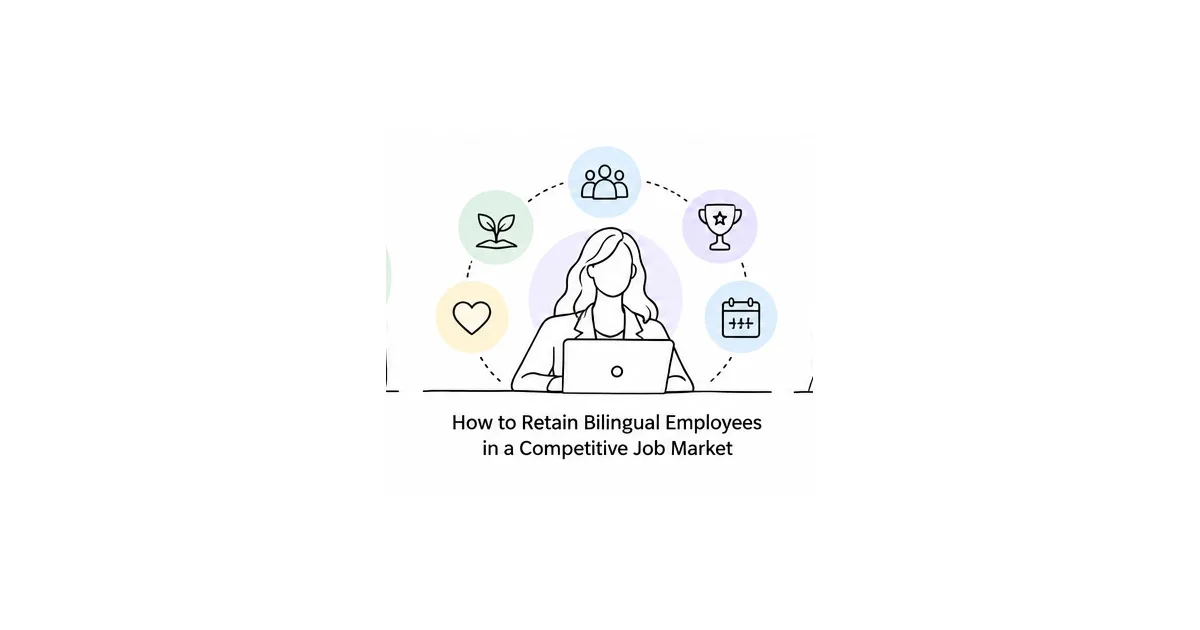
How to Retain multilingual Employees in a Competitive Job Market
Finding employees who combine strong professional skills with the language proficiency your business needs can be challenging. Keeping those employees engaged and helping them develop their careers is just as important.
Organizations may invest considerable resources in sourcing candidates, assessing language proficiency, and onboarding new hires, only to lose experienced employees who feel underpaid, overworked, or overlooked for advancement.
multilingual employees can bring significant value to businesses serving multilingual customers, expanding into international markets, or managing cross-border relationships. However, language skills can also create additional responsibilities that are not always reflected in an employee's job description, workload, or compensation.
For US employers, effective retention starts with recognizing multilingual ability as a professional skill that deserves appropriate support and development.
Here are four practical strategies to help retain multilingual employees in a competitive job market.
1. Compensate Fairly for Required Language Skills
One potential source of frustration is being expected to use a second language regularly without that responsibility being reflected in compensation or career progression.
For example, a customer service representative might be hired to handle English-language inquiries but also become responsible for complex Spanish-language escalations. Similarly, an account manager might be expected to conduct sales calls and negotiate contracts in Mandarin alongside their existing responsibilities.
If language proficiency is an essential part of the job, employers should consider whether the role's salary appropriately reflects its requirements.
Actionable Retention Strategies
Review language pay differentials. Consider a language premium, salary adjustment, or other compensation structure when a role requires verified proficiency that is difficult to source and important to business performance.
Benchmark compensation regularly. Compare salaries for similar roles in your industry and location, taking into account experience, responsibilities, and the required level of language proficiency.
Recognize measurable contributions. Include relevant outcomes in performance reviews, such as multilingual customer satisfaction, successful account management, or support for international business development.
Apply compensation policies consistently. Establish clear criteria for any language premium, including the proficiency level required, how frequently the language is used, and the responsibilities involved.
A separate language premium is not necessary for every multilingual employee. The important point is to ensure that compensation fairly reflects the requirements and responsibilities of the role.
2. Prevent Role Creep and Protect Employees' Time
multilingual employees can quickly become the unofficial translation service for their entire organization.
A colleague might ask them to proofread an email. Another department requests help translating a presentation. Before long, the employee is spending hours on translation, interpretation, or localization tasks that were never part of their original responsibilities.
This can create competing priorities, increase workload, and make it harder for employees to meet their main performance objectives.
It can also create quality and compliance risks when employees are asked to translate specialized material without the necessary training or when confidential information is shared through inappropriate channels.
Actionable Retention Strategies
Define responsibilities clearly. Specify when employees are expected to use their language skills and which translation or interpretation tasks fall outside their role.
Set up a formal request process. Direct translation requests to an appropriate manager or designated service rather than allowing departments to make unlimited informal demands.
Use professional language services when appropriate. For complex legal, medical, technical, or marketing content, consider qualified translators or localization specialists.
Give managers authority to prioritize work. If multilingual requests compete with core responsibilities, managers should help employees agree on priorities and realistic deadlines.
Recognize additional duties. If translation, interpretation, or localization becomes a substantial and ongoing responsibility, review the role, workload, and compensation accordingly.
The goal is not to discourage employees from sharing their language skills. It is to ensure that this contribution is planned, valued, and sustainable.
3. Create Clear Career Advancement Opportunities
multilingual employees should have opportunities to advance beyond roles that primarily involve answering calls or resolving customer inquiries in another language.
When language skills become the main reason an employee is kept in a frontline position, their wider professional abilities can be overlooked. Over time, this can leave experienced employees feeling that their language proficiency is limiting their career rather than helping it progress.
Employers can address this by connecting language skills with broader professional development.
Actionable Retention Strategies
Create visible career pathways. Show how multilingual customer service, sales, or operations roles can lead to account management, team leadership, project management, or international business development.
Invest in transferable skills. Offer training in leadership, data analysis, project management, product knowledge, or other capabilities relevant to future roles.
Include multilingual employees in strategic projects. Where appropriate, involve them in international market research, multilingual customer experience initiatives, and cross-border business development.
Use consistent promotion criteria. Evaluate employees on their performance, leadership potential, and job-related competencies rather than treating language ability as their defining attribute.
Offer mentoring and development plans. Discuss career goals during regular performance reviews and identify practical steps toward promotion.
A multilingual employee may understand customer needs in a particular market, but that does not mean they should automatically be responsible for every international project. Assign opportunities according to their interests, expertise, and career goals.
The strongest retention strategies help employees build a future within the organization, whether that future involves language-focused work or a broader leadership role.
4. Build an Inclusive and Supportive Workplace
multilingual employees often help colleagues and customers navigate differences in language, communication, and business expectations. Organizations should recognize this contribution without assuming that every multilingual employee has the same cultural knowledge, preferences, or experiences.
An inclusive workplace makes it easier for employees to contribute their expertise, raise concerns, and develop professionally.
It also recognizes that communicating in a second language throughout the workday can require sustained concentration, particularly when employees handle complaints, technical discussions, or sensitive conversations.
Actionable Retention Strategies
Train managers to communicate inclusively. Encourage clear instructions, constructive feedback, and awareness of different communication preferences without relying on cultural stereotypes.
Monitor workload and fatigue. Check whether employees who regularly switch languages have realistic workloads, sufficient breaks, and appropriate support for demanding assignments.
Create opportunities for employee feedback. Ask multilingual team members whether their responsibilities, recognition, and career opportunities reflect their contributions.
Support employee networks and mentoring. Where employees are interested, provide opportunities to share experiences, build professional connections, and support one another's development.
Make advancement accessible to everyone. Ensure that multilingual employees have equal access to training, high-visibility projects, and leadership opportunities.
Cultural inclusion should be part of the organization's wider management practices, not an additional responsibility placed solely on employees from different linguistic or cultural backgrounds.
How to Measure multilingual Employee Retention
Retention initiatives are more effective when employers review whether they are making a meaningful difference.
Consider tracking a small set of measures over time:
Retention rates: Compare turnover among employees in language-dependent roles with relevant teams or roles, taking differences in responsibilities and experience into account.
Employee engagement: Ask whether staff feel fairly compensated, supported by their managers, and able to develop their careers.
Workload distribution: Review how much time employees spend on language-related duties outside their primary responsibilities.
Internal progression: Track access to promotions, training, and higher-responsibility assignments.
Business outcomes: Where measurable, review customer satisfaction, service quality, and outcomes associated with multilingual support.
Use these measures to identify problems and improve working conditions rather than assuming that every departure has the same cause.
The Bottom Line
Retaining multilingual employees is about more than offering attractive benefits. It requires organizations to recognize the value of language skills, set reasonable boundaries around additional responsibilities, provide meaningful career opportunities, and build an inclusive workplace.
When employees feel that their contributions are fairly rewarded and their professional ambitions are supported, they have stronger reasons to build a long-term career with your organization.
Building a team that can serve customers across languages and markets? LingoLava connects businesses with skilled multilingual professionals across industries and functions. Contact LingoLava to discuss your hiring needs and find talent whose language skills and professional experience align with your business goals.