What Does Business Fluency Really Mean? A Practical Guide for Employers
Every week, hundreds of job descriptions ask for candidates who are "business fluent" in a specific language. It sounds professional, precise, and reassuring.
Yet ask three different hiring managers what "business fluent" actually means, and you may get three very different answers.
To one manager, it means delivering a persuasive presentation to senior executives in Tokyo. To another, it means writing clear, grammatically correct emails to international clients without relying on translation tools.
The problem is that when a key hiring requirement is this vague, employers risk attracting candidates whose language skills do not match the role. At the same time, qualified applicants may rule themselves out because they underestimate their abilities or interpret the requirement too strictly.
The solution is to define business fluency in practical terms and assess candidates against the communication tasks they will actually perform.
Here is what business fluency involves, how to define it in a job description, and three practical ways to assess it during recruitment.
What Is Business Fluency?
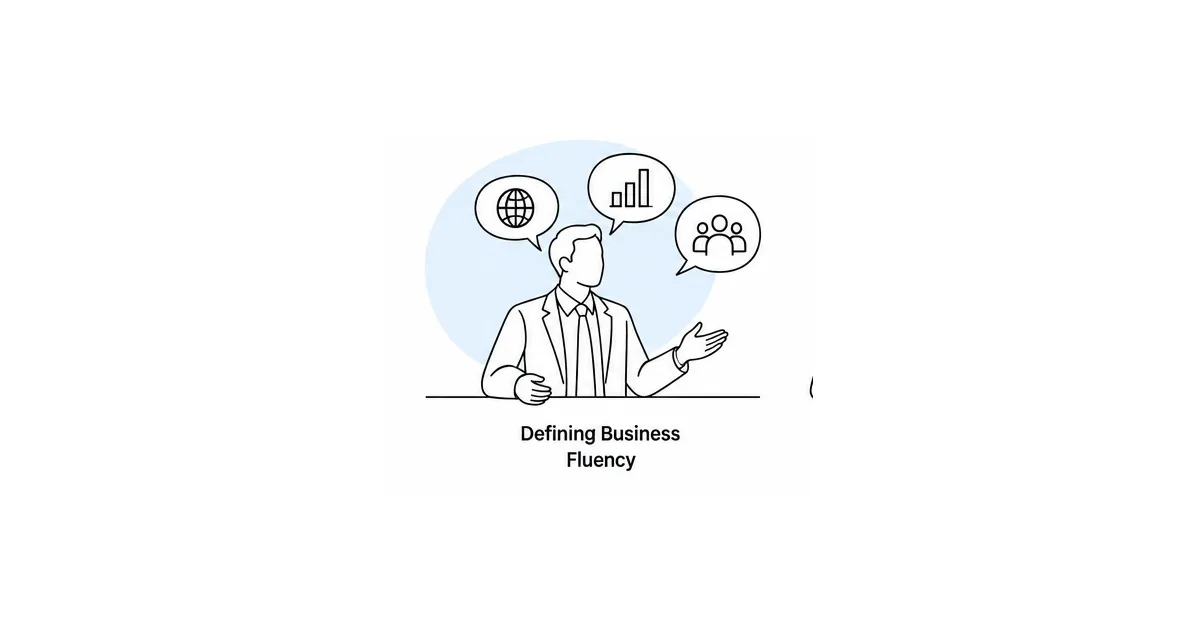
Business fluency is the ability to use a language effectively in a professional environment. It goes beyond everyday conversation, encompassing the communication skills needed to work with colleagues, serve customers, negotiate with clients, and navigate professional situations.
To understand the concept, it helps to distinguish between everyday conversational ability and advanced professional communication.
Conversational proficiency: The ability to participate in everyday discussions, socialise with colleagues, and talk about familiar subjects. The level of proficiency can vary, and some speakers will be able to handle considerably more complex conversations than others.
Business fluency: The ability to communicate effectively in work-related situations, adapting language, tone, and approach to the audience, context, and demands of the role.
Advanced language proficiency: The ability to understand and communicate complex ideas with a high degree of precision, flexibility, and nuance across a wide range of situations.
These categories are useful descriptions rather than rigid levels. Someone can be highly proficient in a language without being familiar with the terminology or communication conventions of a particular industry.
Importantly, business fluency does not require a native accent or perfect grammar. What matters is whether the individual can communicate clearly, accurately, and appropriately to meet the demands of the job.
In practice, a business-fluent candidate should be able to demonstrate three important capabilities.
1. Handle Unexpected Questions and Challenges
Professional conversations rarely follow a script. Candidates may need to respond to objections, explain a complicated issue, address a complaint, or answer an unexpected question.
A strong candidate can follow the conversation, explain their position, ask clarifying questions, and respond appropriately without routinely relying on another language.
2. Adapt Communication to the Audience
Communicating with a colleague on Slack requires a different approach from presenting a proposal to a senior executive or negotiating commercial terms with a client.
Candidates need to recognise these differences and adapt their vocabulary, tone, formality, and level of detail accordingly.
3. Understand Context and Professional Nuance
Effective communication involves more than knowing the correct words. It also requires interpreting meaning in context, recognising implied requests, understanding appropriate levels of formality, and responding sensitively to cultural and professional differences.
These skills can be particularly important in international sales, account management, customer service, and negotiations, where misunderstandings can affect client relationships and commercial outcomes.
How to Define Business Fluency in a Job Description
If you want to hire the right person, avoid listing "business fluent" as a standalone requirement without explaining what it means for the role.
Instead, describe the communication tasks the successful candidate will need to perform.
Instead of writing:
"Must be business fluent in German."
Try writing:
"Professional German proficiency required. The successful candidate will lead product demonstrations, discuss pricing and commercial terms with clients, and prepare client-facing follow-up emails in German."
Where appropriate, you can also specify a recognised proficiency level, such as C1 on the Common European Framework of Reference for Languages (CEFR).
For example:
"C1-level German preferred, with demonstrated experience communicating with business clients, presenting product information, and handling commercial discussions in German."
The distinction matters. A proficiency level provides a useful benchmark, while the practical requirements explain what the candidate must be able to do.
Be clear about which skills are essential and which can be developed on the job. A position involving routine customer enquiries may require a different level of proficiency from one involving complex negotiations or technical presentations.
This approach helps candidates assess their suitability more accurately and gives recruiters a clearer basis for evaluating applications.
3 Practical Ways to Assess Business Fluency
CVs and self-assessments can provide useful starting points, but they do not always reveal how someone will perform in a professional conversation or workplace situation.
Rather than relying solely on informal chat, use structured assessments that reflect the actual demands of the role.
1. The Written Scenario Test
<text color="secondary" size="sm">Suggested duration: 15 to 20 minutes</text>
Give the candidate a realistic workplace scenario in the target language. For example, an enterprise customer has experienced a delayed delivery and is requesting a discount.
Ask the candidate to draft a professional email that acknowledges the problem, addresses the customer's concerns, and explains the next steps.
What to look for:
Clarity: Is the message easy to understand, logically organised, and accurate?
Tone: Does the candidate strike the right balance between professionalism, empathy, and diplomacy?
Problem-solving: Does the response address the customer's concerns and offer an appropriate way forward?
Language control: Can the candidate communicate effectively without errors that obscure meaning or create ambiguity?
The aim is not to demand flawless writing. It is to determine whether the candidate can produce the standard of written communication the job requires.
2. The Unscripted Problem-Solving Interview
<text color="secondary" size="sm">Suggested duration: 10 to 15 minutes</text>
Conduct a short section of the interview in the target language. Instead of relying on predictable questions about hobbies or personal interests, introduce a realistic workplace challenge.
For example:
"Imagine our product experienced a two-hour outage yesterday. How would you explain the situation to an important client in German, reassure them, and respond if they questioned our reliability?"
Follow up with questions that require the candidate to think on their feet.
You might ask what they would do if the client demanded compensation, requested a technical explanation, or threatened to end the contract.
What to look for:
Can the candidate understand questions and respond appropriately?
Can they explain complex information in a way the intended audience can understand?
Do they handle follow-up questions without losing track of the discussion?
Can they clarify a point or rephrase an answer when necessary?
Do they communicate with confidence while remaining accurate and professional?
A strong candidate does not need to speak without hesitation or use elaborate vocabulary. The priority is effective communication, including the ability to recover from uncertainty and keep the conversation moving.
3. Use Independent Language Assessments
<text color="secondary" size="sm">Particularly useful when your team does not speak the target language</text>
If your internal team cannot confidently assess a candidate's language skills, consider using a professional language assessment provider.
Services such as Pipplet, Emmersion, and Berlitz offer language assessment solutions that can help employers evaluate proficiency. Depending on the provider and assessment, these may cover speaking, writing, listening, or other relevant skills.
The CEFR framework is another useful reference point for describing language proficiency.
B1: Can communicate about familiar work-related subjects, although complex discussions may present challenges.
B2: Can interact with a degree of fluency and spontaneity, including many professional situations.
C1: Can use language flexibly and effectively for social, academic, and professional purposes, including complex discussions.
C2: Can understand virtually everything heard or read with ease and express meaning precisely in demanding situations.
These levels should not be treated as automatic hiring decisions. A B2 candidate may be suitable for a role involving routine customer communication, while a position requiring complex negotiations may justify a higher threshold.
Equally, a C1 rating does not guarantee expertise in technical terminology, sales negotiations, or industry-specific communication. These capabilities should be assessed separately when they are important to the role.
The most reliable approach is to combine a recognised proficiency benchmark with practical exercises relevant to the job.
The Bottom Line
Business fluency is not about having a perfect accent, never making grammatical mistakes, or sounding like a native speaker. It is about communicating effectively in the situations that matter to the job.
For employers, the key is to move beyond vague labels and define the specific language skills each position requires. For recruiters, it means looking beyond a candidate's self-reported proficiency and gathering evidence of how they communicate in practice.
By combining clear job specifications, realistic workplace scenarios, and structured language assessments, businesses can make more consistent and informed hiring decisions.
The result is a fairer process for candidates and a better chance of finding people who can communicate effectively with colleagues, customers, and clients from day one.